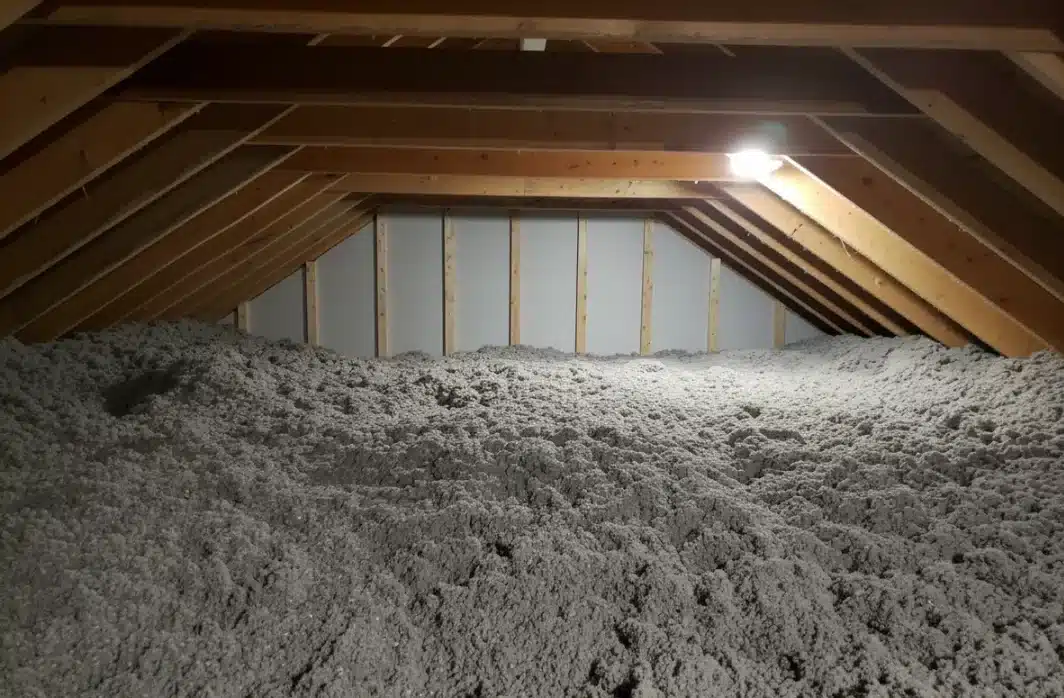
Why Pole Barn Insulation Outperforms Standard Insulation
admin-prosealspray
April 28th, 2026
Pole barns and post-frame buildings are not standard construction, and treating them like typical stick-built homes when it comes to insulation is a mistake that costs owners thousands in energy waste, moisture damage, and premature material deterioration. Standard insulation like fiberglass batts and blown-in cellulose was designed for framed walls with predictable cavities, drywall barriers, and conventional vapor control systems. Pole barns operate differently: they feature exposed structural framing, metal roofing and siding, large open volumes, and minimal built-in air barriers. That mismatch is exactly why specialized pole barn insulation, particularly spray foam, consistently outperforms standard insulation in these structures. The right approach depends on your climate zone, how you plan to use the building, and whether the space is heated, cooled, or conditioned year-round.
TL;DR
Spray foam delivers R-6.0 to R-6.5 per inch, compared to R-3.0 to R-4.3 per inch for fiberglass, meaning pole barns achieve higher thermal resistance with less material thickness.
Spray foam expands to fill every gap, crack, and irregular cavity in post-frame construction, creating a continuous air barrier that standard batts simply cannot replicate.
Condensation is the single most damaging problem in uninsulated or poorly insulated pole barns, and spray foam’s built-in vapor retarder properties directly address this issue at the source.
The EPA estimates that proper air sealing combined with insulation can reduce heating and cooling costs by an average of 15% nationally, with savings reaching up to 19% in colder northern climate zones.
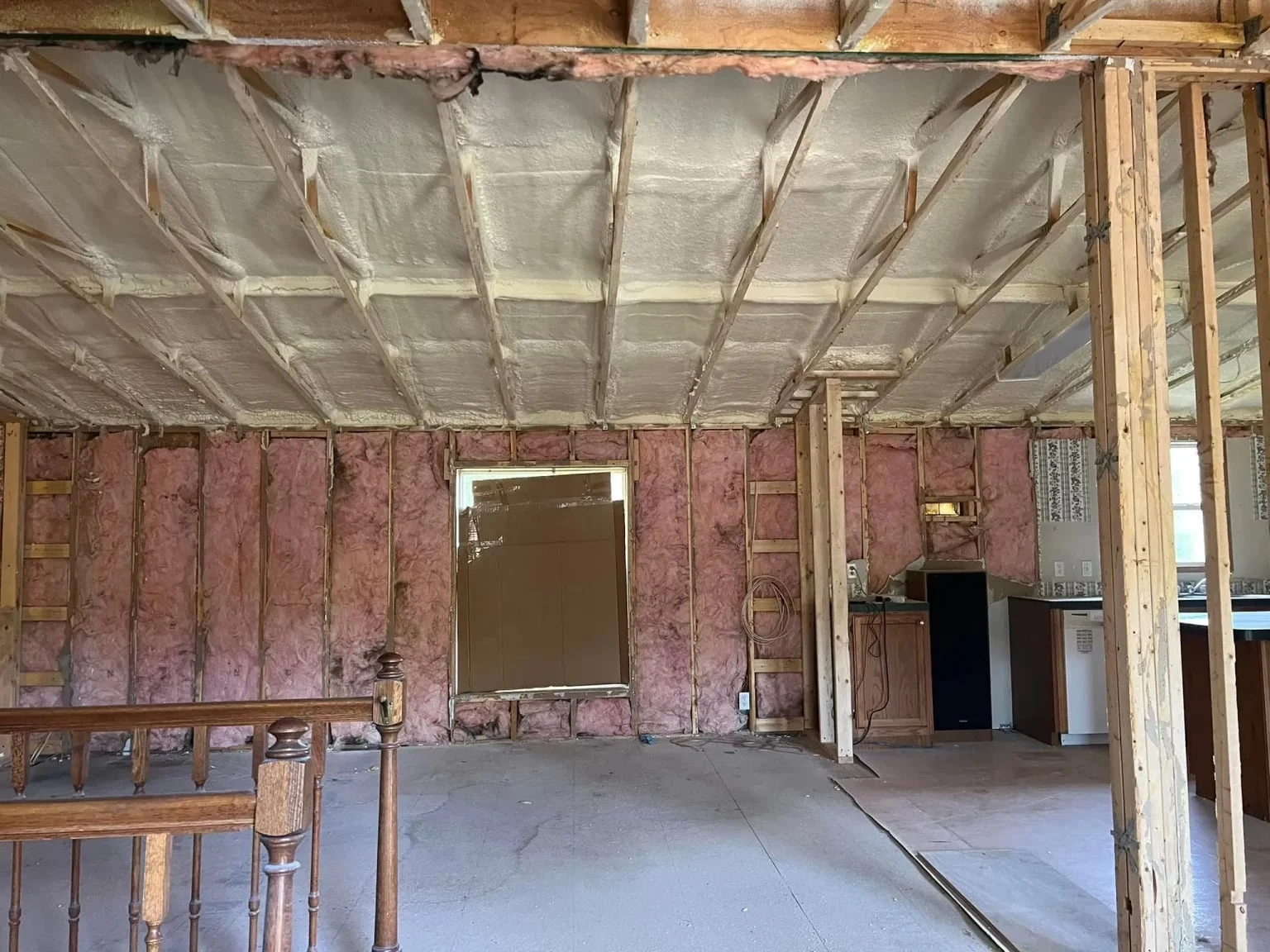
Fiberglass and mineral wool in pole barns require separate vapor barriers, housewrap, caulking, and taping to approach the air sealing that spray foam achieves in a single application.
Closed-cell spray foam adds structural rigidity to pole barn walls and roof decks, reducing flex and racking in large open-span buildings.
The NFBA recommends integrated insulation strategies for post-frame buildings that account for thermal bridging through posts and girts, a problem spray foam is well-suited to solve.
The Structural Problem With Standard Insulation in Pole Barns
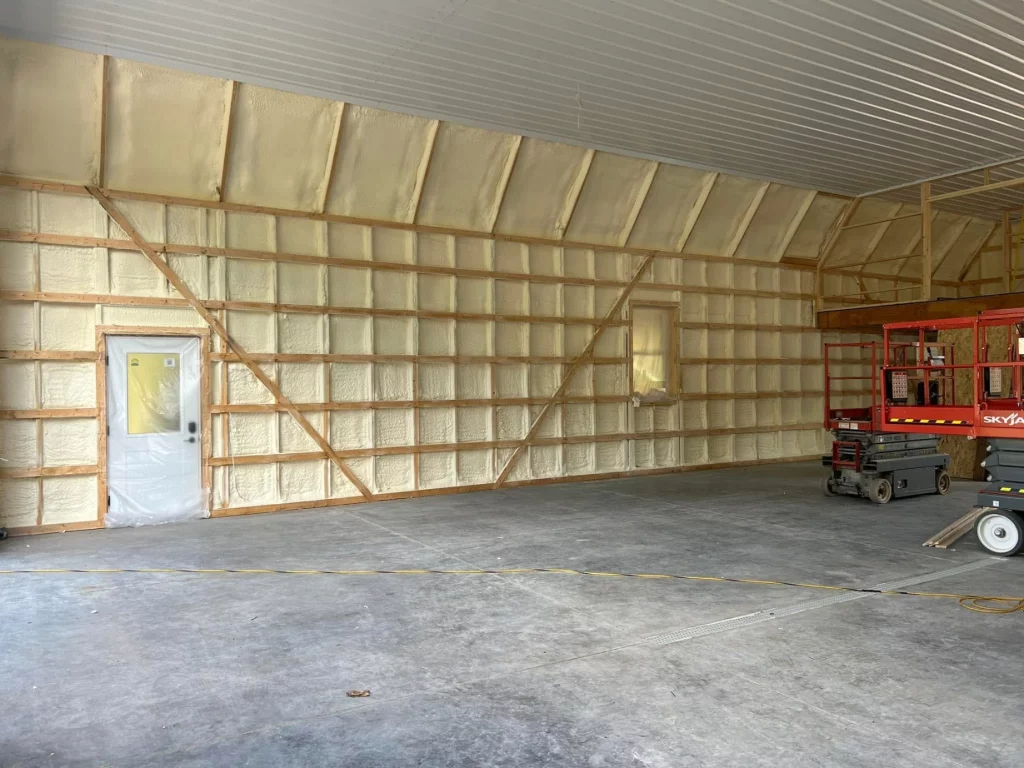
Pole barns are built on a post-frame system where vertical posts are set into the ground or on footings, with horizontal girts spanning between them. Metal panels attach directly to the girts on the exterior. This design creates several challenges for standard insulation:
Irregular cavities and gaps. Post-frame walls often have varying cavity widths, not the uniform 16 or 24 inches on center that fiberglass batts are manufactured for. Girts create thermal bridges where heat transfers directly through the wood and metal fasteners to the exterior. Batts leave air gaps around these obstructions, which allows conditioned air to escape and unconditioned air to infiltrate.
No natural air barrier. Stick-built homes have sheathing, housewrap, and drywall that form multiple air barrier layers. Pole barns often have nothing but metal panels on the outside and open framing on the inside. Without a dedicated air barrier, standard insulation relies entirely on friction fit to resist air movement, which is insufficient in buildings subject to wind loading and stack-effect pressure.
Metal roofing condensation. Metal roofs cool rapidly at night or during cold weather. When warm, humid interior air contacts the cold metal underside, condensation forms and drips onto whatever is below. Standard fiberglass batts absorb this moisture, lose their insulating effectiveness, and can promote mold growth and wood rot on the structural framing.
The U.S. Department of Energy confirms that the maximum thermal performance of insulation is heavily dependent on proper installation, and that foam insulation fills even the smallest cavities while creating an effective air barrier, a quality especially important in non-standard construction like post-frame buildings.
How Spray Foam Solves Pole Barn-Specific Problems
Spray foam insulation addresses the unique challenges of pole barn construction in ways that standard insulation cannot:
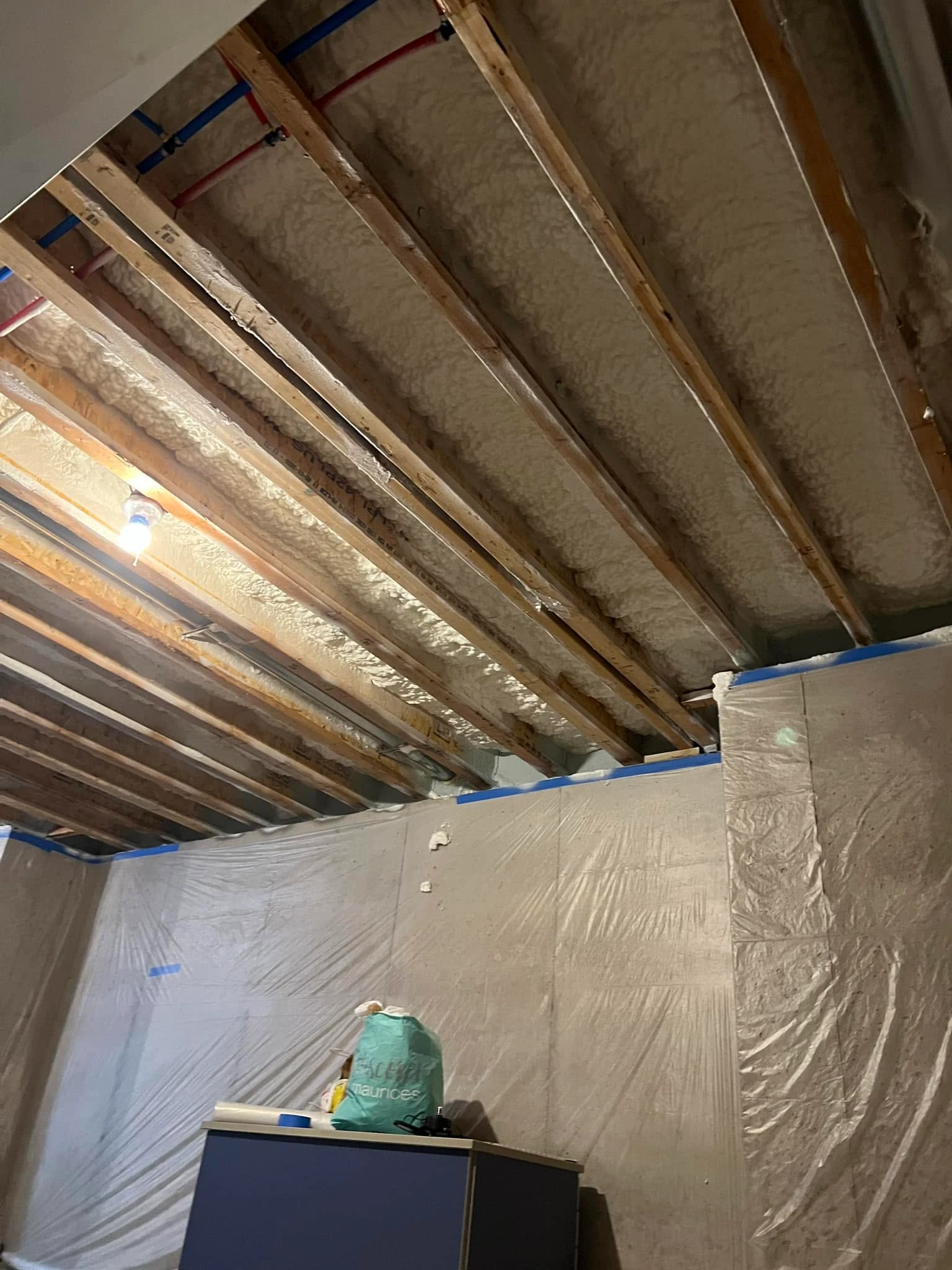
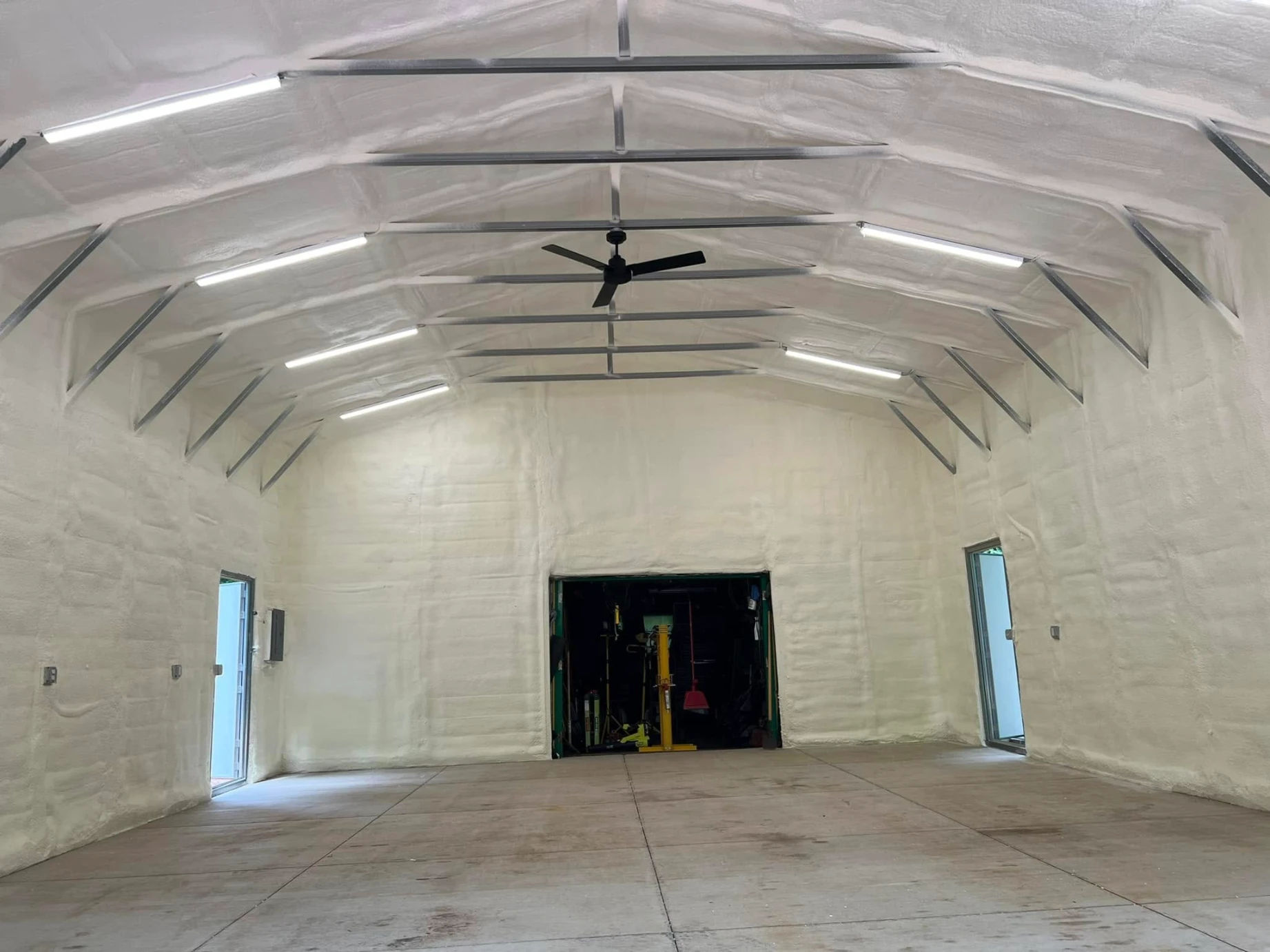
Air sealing and insulation in one step. When spray foam is applied to pole barn walls and roof decks, it expands to fill every crack around girts, posts, purlins, and fastener penetrations. This eliminates the need for separate caulking, housewrap, and vapor barrier installation. According to the DOE, foam insulation’s higher R-values and built-in air barrier can eliminate other costs and tasks associated with weatherizing a structure.
Condensation control. Closed-cell spray foam has a permeance rating low enough to function as a vapor retarder. When applied directly to the underside of metal roofing and against metal wall panels, it prevents warm interior air from reaching the cold metal surface where condensation would form. This is particularly important because the Insulation Institute notes that no insulation product alone can prevent all moisture-related problems, but the air sealing and vapor retarder properties of spray foam come closest in pole barn applications.
Thermal bridging reduction. By spraying foam directly over girts and purlins, you create a continuous layer of insulation that interrupts the thermal path through structural members. Standard batts fit between framing but leave the framing itself exposed, creating a pattern of hot and cold spots across the wall and ceiling surfaces.
Performance Comparison: Spray Foam vs. Standard Insulation
Factor
Spray Foam (Closed-Cell)
Fiberglass Batts
Blown-In Cellulose
R-Value Per Inch
R-6.0 to R-6.5
R-3.0 to R-4.3
R-3.2 to R-3.8
Air Barrier
Yes, built-in
No, requires a separate barrier
No, requires a separate barrier
Vapor Retarder
Yes, Class II
Requires Kraft facing or a separate barrier
Varies, requires a separate barrier
Condensation Control
Excellent
Poor, absorbs moisture
Moderate, can settle and leave voids
Fits Irregular Cavities
Expands to fill any shape
Pre-cut widths, poor fit in post-frame
Conforms well but settles over time
Structural Benefit
Adds rigidity
None
None
Installation
Professional only
DIY possible
Professional recommended
Lifespan
80+ years, does not sag or settle
Can sag and lose contact with the framing
Can settle up to 20% over time
The R-value advantage alone is significant. Achieving R-19 in a pole barn wall cavity requires roughly 5.5 inches of closed-cell spray foam, compared to nearly 6 inches of fiberglass, and the spray foam version also provides air sealing, vapor control, and structural reinforcement that the fiberglass does not.
Energy Savings That Justify the Investment
The upfront cost of spray foam insulation is higher than fiberglass or cellulose, and we are upfront about that with every client. But the long-term financial picture tells a different story.
ENERGY STAR data shows that homeowners who properly air seal and insulate their buildings save an average of 15% on heating and cooling costs, with northern climate zones seeing savings as high as 18 to 19% on HVAC costs alone. Pole barns, with their large roof areas, metal exteriors, and minimal built-in insulation, often see even greater percentage improvements because the starting efficiency baseline is so low.
Beyond direct utility savings, spray foam insulation in pole barns contributes to:
Reduced HVAC equipment sizing, since the heating and cooling load drops meaningfully with a properly sealed and insulated envelope
Lower maintenance costs, because condensation-related rust on metal components and rot on wood framing are largely eliminated
An extended building lifespan, as moisture damage is the leading cause of premature deterioration in post-frame structures
Improved usability, allowing the space to maintain consistent temperatures for workshops, livestock, equipment storage, or living quarters
Choosing the Right Insulation for Building Use
Not every pole barn needs closed-cell spray foam throughout. The right approach depends on how the building is used and what the budget allows.
Year-round heated and conditioned space. Workshops, home offices, and living quarters inside pole barns benefit most from a full closed-cell spray foam application on walls and ceilings. The air sealing, vapor control, and high R-value are essential for comfort and energy efficiency in spaces occupied daily.
Seasonal use or occasional heating. Garages, equipment storage, and hobby spaces used primarily in cooler months can use a hybrid approach: closed-cell spray foam on the roof deck for condensation control, with fiberglass or mineral wool in the walls where budget is a bigger concern. The roof is where condensation does the most damage, so prioritizing foam there is a smart compromise.
Unheated storage and livestock buildings. Dairy barns, horse arenas, and cold storage buildings still benefit from spray foam on the roof deck to prevent condensation dripping on animals and stored goods. Wall insulation may not be necessary if the building is intentionally left unconditioned.
Signs You Have the Right Insulation Strategy
When evaluating insulation for your pole barn, look for these indicators that your approach is sound:
The contractor discusses condensation before R-value. A professional who understands post-frame construction knows that moisture control is the first priority, not thermal resistance. If the conversation starts and ends with R-value per inch, that is a red flag.
The proposal addresses air sealing as a system. Spray foam is part of an air barrier strategy, not the whole story. A thorough proposal includes attention to doors, windows, ridge vents, and floor-to-wall transitions.
There is a clear vapor control plan. In mixed climates, the vapor drive direction changes seasonally. The right insulation strategy accounts for this with materials and placement that work in both heating and cooling seasons.
The installer has experience with post-frame buildings. Pole barns are not the same as residential walls. The framing geometry, fastener patterns, and metal-to-wood transitions require specific knowledge that general residential insulation experience may not cover.
The estimate includes a thermal barrier discussion. Building codes require spray foam to be covered with a thermal barrier, like half-inch gypsum board in occupied spaces. A reputable contractor addresses this upfront rather than leaving it as a surprise for later.
Common Mistakes to Avoid
We see the same errors repeated across pole barn insulation projects, and they are almost always the result of applying standard residential insulation thinking to post-frame construction:
Installing fiberglass against metal roofing without an air gap or vapor barrier. This traps moisture between the batts and the metal, accelerating corrosion and rot.
Using kraft-faced batts in the wrong climate zone. A vapor barrier on the wrong side of the insulation in a heating-dominant climate can trap moisture inside the wall cavity.
Ignoring the floor slab. Ground-coupled slabs in heated pole barns can account for significant heat loss. Edge insulation and vapor barriers under the slab are often overlooked.
Skipping ventilation planning. Tightly sealing a pole barn without providing adequate ventilation can create indoor air quality problems, particularly in buildings housing livestock or using combustion heating equipment.
Get a Professional Pole Barn Insulation Assessment
At Proseal Spray Foam, our team specializes in insulation solutions designed for post-frame and pole barn construction. We assess each building’s unique framing, metal roofing, climate exposure, and intended use before recommending the insulation approach that delivers the best long-term performance and value. Whether you are building new or retrofitting an existing pole barn, we will help you avoid the moisture and energy loss problems that plague buildings insulated with standard materials.
Call us at (715) 227-6295 or email [email protected] to discuss your pole barn insulation project with our experienced team.
Frequently Asked Questions
Can I install fiberglass batts in my pole barn instead of spray foam?
Fiberglass can work in pole barn walls if the cavities are uniform and you add a separate air barrier and vapor retarder, but it will not address condensation on metal roofing the way spray foam does.
Does spray foam void the warranty on my metal roofing?
Most metal roofing manufacturers do not warranty against interior condensation damage regardless of insulation type, but spray foam applied to the underside of panels is widely accepted. Check your specific warranty terms.
How much does pole barn spray foam insulation cost?
Costs vary based on building size, foam thickness, and whether the project is new construction or a retrofit. Request a quote based on your specific building dimensions and usage needs.
Is open-cell or closed-cell spray foam better for a pole barn?
Closed-cell is generally preferred for pole barns because of its higher R-value, vapor retarder properties, and structural reinforcement. Open-cell can be used in wall cavities in drier climates where moisture risk is lower.
How long does spray foam insulation last in a pole barn?
Properly installed spray foam is a permanent insulation solution that does not settle, sag, or degrade over time. It maintains its R-value and air sealing properties for the life of the building.
Sources
U.S. Department of Energy – Types of Insulation – Comprehensive overview of insulation materials, installation methods, and performance characteristics, including spray foam R-values and air barrier properties.
Insulation Institute – Comparing Insulation Types – Industry resource comparing fiberglass, mineral wool, cellulose, and spray foam across performance, air sealing, moisture, and installation quality factors.