How Much Does Blown-In Cellulose Insulation Cost and What Determines the Price?
Installing blown-in cellulose insulation costs typically start from $1.67 to $2.92 per square foot, though your final price will depend…


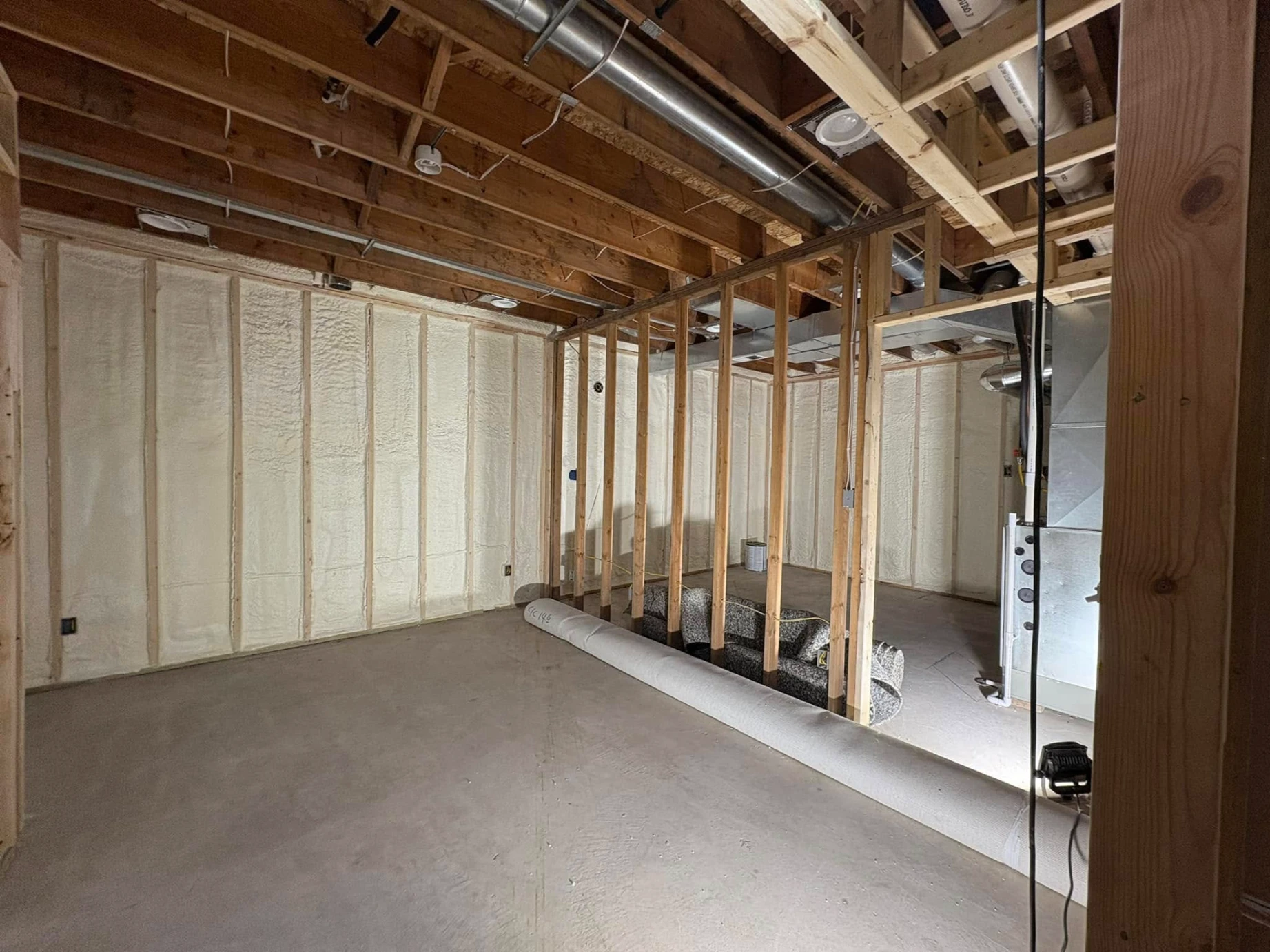
Closed-cell spray foam does more than insulate your home. When sprayed into wall cavities, crawl spaces, and attic assemblies, it bonds directly to framing members and sheathing, creating a rigid monolithic layer that reinforces the entire structural assembly. For homeowners in Wisconsin Rapids, WI, where winter temperatures regularly drop below zero, and seasonal storms bring heavy winds, this added structural rigidity addresses real building science challenges specific to our Climate Zone 6 environment. The extent of that reinforcement depends on factors like foam density, application thickness, and the condition of the existing structure, but the research consistently shows measurable gains in racking strength, wind resistance, and overall wall assembly durability when closed-cell foam is properly installed.
Wisconsin Rapids falls within USDA Hardiness Zones 4b and 5a, meaning winter temperatures can reach as low as -25°F. The International Energy Conservation Code (IECC) places the area in Climate Zone 6, one of the colder classifications in the continental United States. Homes here endure a demanding cycle of deep freezes, spring thaws, and summer storms that create consistent structural stress.
The combination of heavy snow loads on roofs, freeze-thaw cycling that can weaken connections over time, and wind events that push laterally against exterior walls means structural integrity matters just as much as thermal performance. Traditional insulation types like fiberglass batts or blown cellulose sit loosely within wall cavities and provide no structural reinforcement whatsoever. That gap between insulation and structural contribution is exactly where closed-cell spray foam fills a practical need.
According to ENERGY STAR’s insulation R-value recommendations, homes in zones 5 through 8 should have R60 in uninsulated attics, R49 where 3 to 4 inches already exist, and R30 in floors over unconditioned spaces. Closed-cell foam’s higher R-value per inch allows these targets to be met within shallower cavities while simultaneously adding structural support that other insulation types cannot provide.
The structural benefit of closed-cell spray foam comes from how it behaves once applied. Unlike batt or blown insulation that simply fills space, closed-cell foam expands during installation, adheres to every surface it contacts, and cures into a rigid, high-density material. That curing process effectively glues the building assembly together.
When wind pushes against an exterior wall, it creates a lateral force known in building science as a shearing force. That force can distort a rectangular wall frame into a parallelogram shape, a failure mode called racking. Wall assemblies are tested for their resistance to this type of force through standardized racking tests, and the results for spray foam are significant.
Research documented by Spray Foam Magazine, based on NAHB Research Center studies, found that walls installed with closed-cell spray foam (at 1.5 lb./cu. ft. density) showed racking strength increases of up to 300% compared to uninsulated wall assemblies. The foam reduces deformation at each incremental force level and allows the wall to withstand higher total loads before failure.
In a separate series of tests cited by the Spray Polyurethane Foam Alliance, medium-density closed-cell foam installed at 2.0 pounds per cubic foot increased racking strength by 70% to 200% in wall assemblies sheathed with OSB, plywood, gypsum wallboard, vinyl siding, and polyiso board. Notably, the gains were even larger on weaker substrates like gypsum and vinyl, meaning homes with less robust exterior finishes stand to benefit the most Spray Foam’s Hurricane, Flood & Wind Resistance Performance.
| Property | Closed Cell Spray Foam | Open Cell Spray Foam | Fiberglass Batts |
|---|---|---|---|
| R-value per inch | 6.5 to 7.0 | 3.5 to 3.8 | 3.1 to 3.4 |
| Density (lb./cu. ft.) | 1.5 to 2.8 | 0.4 to 0.5 | 0.5 to 1.0 |
| Structural adhesive bond | Yes | Minimal | No |
| Racking strength improvement | 70% to 300% | Negligible | None |
| FEMA flood resistance rating | Class 5 | Not rated | Not rated |
| Water absorption | Low (<1%) | High (absorbs water) | High (absorbs water) |
| Air barrier capability | Yes (Class II vapor retarder) | Yes (air barrier only) | No |
| Wind uplift resistance | Proven benefit | No proven benefit | No benefit |
The structural benefits extend beyond walls. When applied to the underside of roof decking, closed-cell spray foam significantly increases wind uplift resistance. The foam adheres to the roof substrate, tying the entire assembly together and reducing the chance that wind forces can separate components.
Building Enclosure reported on testing that demonstrated closed-cell spray foam adds tensile strength, averaging 15 to 25 psi when installed in above-grade walls. The material essentially glues the assembly together, reduces the potential for movement, and eliminates the need for special wind-bracing in many wall configurations. For roofing applications, denser closed-cell foam at around 2.8 pounds per cubic foot delivers compressive strength of approximately 40 to 55 psi.
After Hurricane Katrina, the National Institute of Standards and Technology reviewed roof damage across the Gulf Coast and found that buildings roofed with spray foam performed well, with no blow-off of the SPF material or damage to flashings. The 2006 report concluded that spray foam kept roofs intact and prevented moisture from entering the structures. While Wisconsin Rapids does not face hurricanes, the same wind mechanics apply during severe thunderstorms and straight-line wind events common to central Wisconsin.
Closed-cell spray foam has an additional advantage that matters for Wisconsin Rapids homeowners: moisture resistance. FEMA classifies closed-cell spray polyurethane foam as a Class 5 material, the highest possible rating for flood damage resistance. Class 5 materials can survive wetting and drying cycles, require no special waterproofing, and can be cleaned after flood exposure to remove harmful pollutants.
According to the [Wisconsin Administrative Code for building standards] homes in Climate Zone 6 require specific minimum insulation levels across attics, walls, floors, and basements. Closed-cell foam not only meets those thermal requirements at thinner profiles but also provides the secondary benefit of acting as a water-resistive barrier when applied to exterior assemblies, tested to withstand water penetration pressures up to 300 Pa without leakage.
Spring flooding and snowmelt are annual concerns in the Wisconsin Rapids area. Homes with closed-cell foam in crawl spaces and basement rim joists gain both the thermal benefit and a material that will not degrade, mold, or lose structural integrity when exposed to moisture.
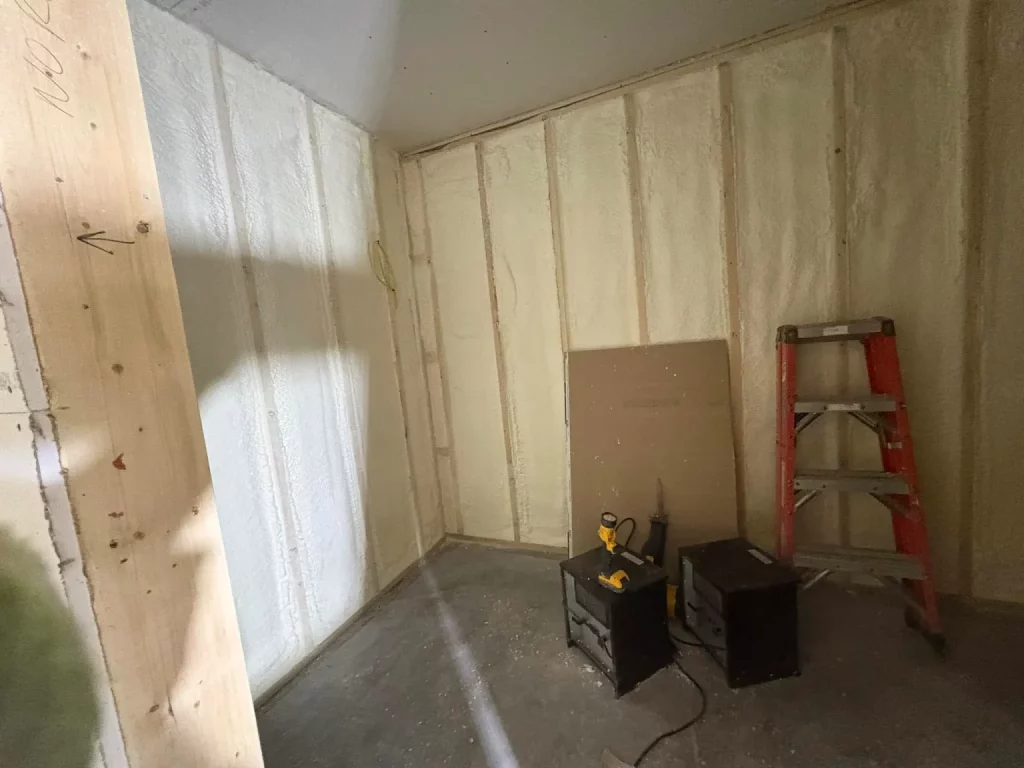
Not every area of a home benefits equally from the structural properties of closed-cell foam. Our experience working in Wisconsin Rapids homes has shown that certain applications offer the highest return on investment.
| Home Type | Recommended Application | Structural Priority | Why |
|---|---|---|---|
| Older homes (pre-1980) | Rim joists, full wall cavities | High | Weakened framing connections benefit most from adhesive bonding |
| New construction | Exterior walls, roof deck | High | Maximizes racking strength from day one |
| Homes near flood zones | Crawl spaces, basement walls | Moderate | FEMA Class 5 rating protects against moisture damage |
| Open floor plan homes | Exterior walls, knee walls | High | Large wall spans without interior support need added rigidity |
| Metal/post-frame buildings | Full envelope spray | Very high | Lighter-gauge metal panels gain significantly from foam bonding |
Choosing who installs your closed-cell foam matters as much as choosing the material itself. The structural benefits only materialize with proper application at the correct density and thickness. Here are the indicators that a contractor is qualified to deliver these results:
Proseal Spray Foam serves homeowners throughout Wisconsin Rapids, WI, with expert closed-cell spray foam installation that strengthens your home’s structure while delivering high-performance insulation. Our team evaluates each wall assembly, roof deck, and foundation area to recommend the appropriate foam density and application method to maximize structural performance and energy efficiency.
Call us at (715) 227-6295 or email [email protected] to discuss how closed-cell foam can protect and strengthen your home.
NAHB Research Center testing showed racking strength increases of 70% to 300%, depending on the wall substrate and foam density used in the assembly.
No. Closed-cell foam reinforces the assembly but does not replace code-required structural sheathing. It works alongside sheathing to improve overall performance.
For most Wisconsin Rapids homeowners, the combination of structural reinforcement, superior R-value per inch, and moisture resistance makes closed-cell foam a strong value, especially in exterior walls and rim joists.
Yes. Testing shows closed-cell SPF adds tensile strength of 15 to 25 psi to wall assemblies and increases wind uplift resistance on roof decking applications.
Wisconsin Rapids is in IECC Climate Zone 6, which requires higher R-values than most of the country. ENERGY STAR recommends R60 for attics and R30 for floors in this zone.